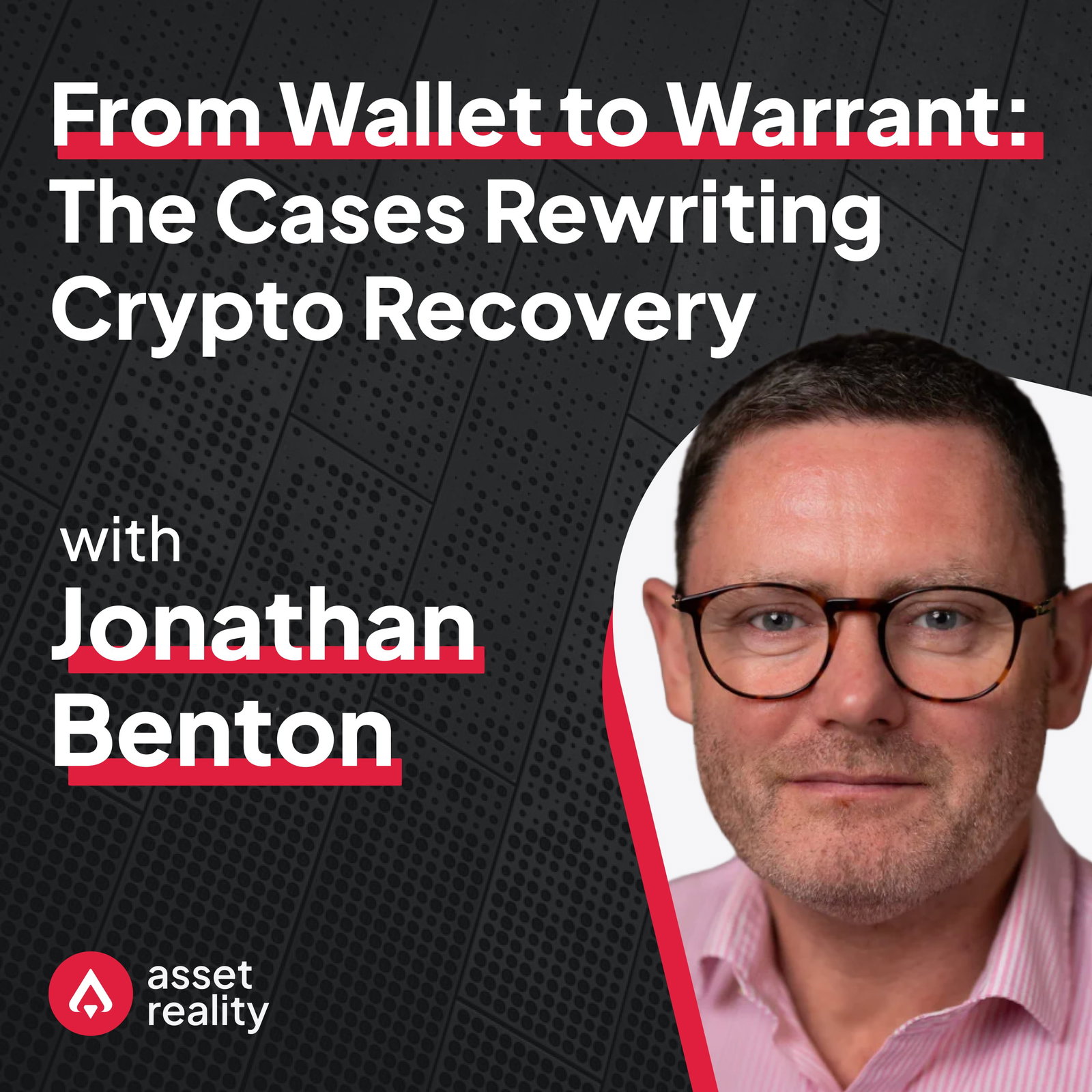
Jason Sandoval speaks with Jonathan Benton, former Head of the UK's Int. Corruption Unit at the National Crime Agency and now CEO and Founder of Intelligent Sanctuary, about the gap between criminal efficiency and institutional deliberation, and what it takes to close it in digital asset recovery. They discuss how immutable on-chain markers are used to identify wallet holders and support compliance with FATF's recommendations, as well as the legal questions being tested in court cases like Tulip, D'Aloia and Jones.
Seize & Desist speaks to practitioners across asset recovery, investigators, policymakers and people building tools in the field. No guest pays to appear, and nothing mentioned, including any tools or technology discussed, is endorsed or commercially connected to Asset Reality.
01:30 – Jonathan’s years in law enforcement
14:45 – marking stolen crypto to identify wallet holders
19:00 – on-chain movement vs wallet attribution
28:45 – legal questions raised by Tulip, D'Aloia and Jones
33:45 – on-chain marking and FATF compliance
45:00 – building the International Anti-Corruption Coordination Centre
Jonathan Benton is CEO and Founder of Intelligent Sanctuary. He spent 30 years in UK law enforcement as a Detective Superintendent and the Head of the NCA's International Corruption Unit, leading some of Britain’s most complex corruption cases, including the Ibori case, the OPL 245 oil block scandal, and the case against the former Nigerian petroleum minister, as well as designing the International Anti-Corruption Coordination Centre.
Agility Is the Real Gap
Criminals move faster than institutions because nobody makes them fill out a form first. Procurement and policy cycles lag years behind criminal adoption of new tools.
On-Chain Visibility Isn't Attribution
Standard blockchain analytics show what happened on-chain, not who controls the wallet behind it. Closing that gap is what makes recovery possible.
Immutable Markers Turn Flags Into Evidence
A wallet marked with a police reference number, visible on any blockchain explorer and removable only by investigators, gives exchanges something concrete to act on.
Courts Are Setting the Rules Case by Case
Tulip, D'Aloia and Jones are testing a different legal questions, from exchange liability to service by NFT, shaping how digital asset recovery works in practice.
- Jonathan Benton on LinkedIn: https://www.linkedin.com/in/jonathanbenton
- Intelligent Sanctuary: https://isanctuary.io
- Cambridge Int. Symposium on Economic Crime: https://www.crimesymposium.org
If you found this episode useful, make sure you:
- Subscribe wherever you listen
- Follow Asset Reality on LinkedIn for updates on future episodes
- Share this episode with your colleagues working in asset recovery, investigations, or financial crime
Our podcasts are for informational purposes only. They are not intended to provide legal, tax, financial, and/or investment advice. Listeners must consult their own advisors before making any decisions on the topics being discussed. Asset Reality has no responsibility or liability for any decision made or any other acts or omissions in connection with your use of this material. The views expressed by guests are their own and their appearance on the program does not imply an endorsement of them or any entity they represent. Views and opinions expressed by Asset Reality employees are those of the employees and do not necessarily reflect the views of the company. Asset Reality does not guarantee or warrant the accuracy, completeness, timeliness, suitability or validity of the information in any particular podcast and will not be responsible for any claim attributable to errors, omissions, or other inaccuracies of any part of such material. Unless stated otherwise, reference to any specific product or entity does not constitute an endorsement or recommendation by Asset Reality.